Who is Horemheb? Everything You Need to Know About the Pharaoh
Horemheb: The Pharaoh Who Restored Egypt's Order

The history of Ancient Egypt is frequently dominated by names that echo through popular culture: Ramesses the Great, King Tutankhamun, and the controversial heretic pharaoh, Akhenaten. However, the survival of the Egyptian empire following the catastrophic internal disruptions of the Amarna Period rests almost entirely upon the shoulders of a man who was never born to be king. Horemheb was the final pharaoh of the Eighteenth Dynasty, reigning from approximately 1319 BC to 1292 BC. His reign represents one of the most critical turning points in antiquity, bridging the gap between the diplomatic failures of the Amarna kings and the military supremacy of the subsequent Ramesside period.
Unlike his immediate predecessors, Horemheb did not possess royal blood. He ascended to the pinnacle of Egyptian power through unparalleled competence on the battlefield and shrewd political maneuvering within the royal courts of three different pharaohs. By the time he claimed the double crown, the Egyptian state was suffering from severe administrative corruption, a depleted treasury, and significantly diminished influence over its vassal states in the Levant. This historical analysis explores the life and legacy of Horemheb, the commoner who became the architect of Egypt's restoration.
Early Egyptian Military Career

Horemheb's origins lie entirely outside the traditional spheres of royal lineage. He was born in the provincial town of Hnes, known to the Greeks as Herakleopolis Magna, located on the western edge of the Nile Valley near the Fayyum region. Historical records suggest his family was of minor provincial nobility, but they held no significant influence in the imperial capital of Thebes. Recognizing that the military offered the most viable path to socio-political advancement, Horemheb enlisted in the armed forces, beginning his career during the early reign of Akhenaten.
During Akhenaten's reign, the Egyptian court relocated to the isolated desert city of Akhetaten (Amarna), and the pharaoh became completely consumed by his monotheistic devotion. While the king composed hymns, Egypt's northern borders were rapidly deteriorating. The increasingly aggressive Hittite Empire, under the command of Suppiluliuma I, began systematically conquering Egyptian vassal states in Syria and the Levant. Horemheb distinguished himself in these escalating border conflicts.
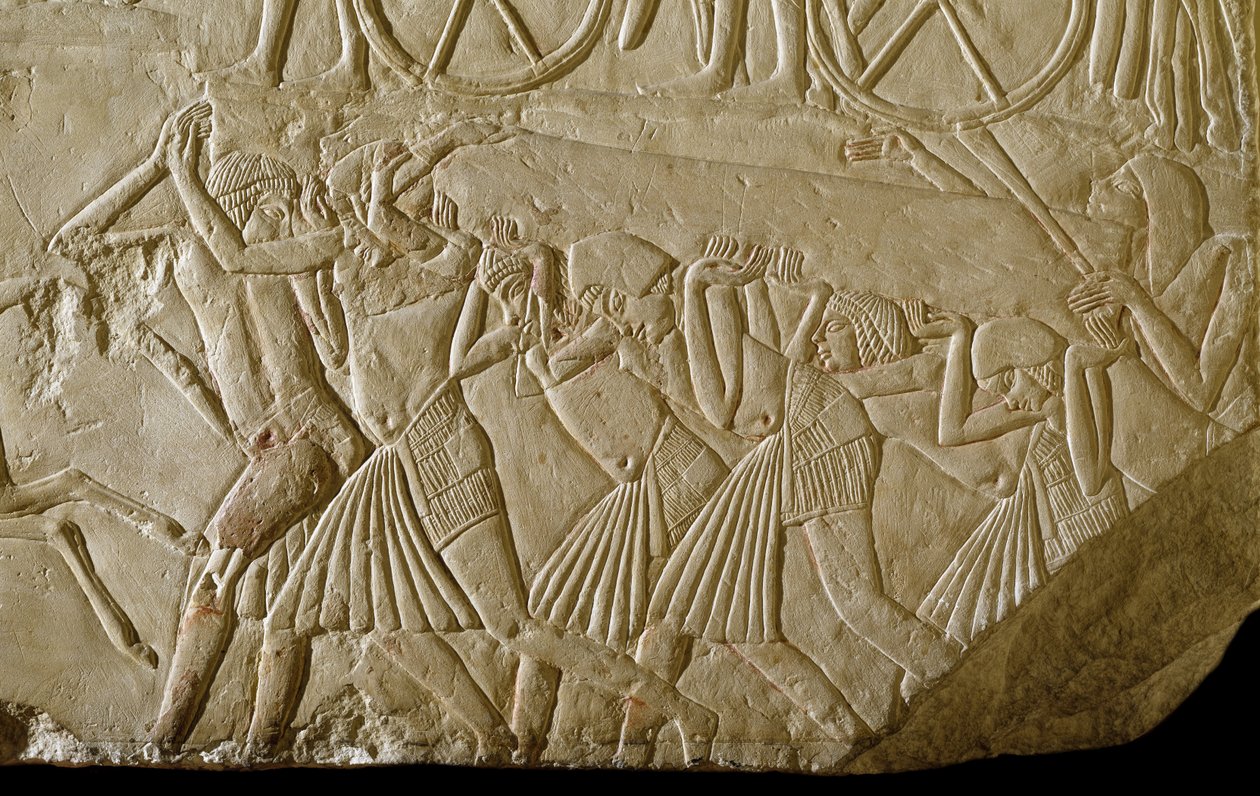
By the conclusion of the Amarna period, Horemheb had risen to the extraordinary rank of "Great Commander of the Army." He became the paramount military authority in the land, responsible for attempting to hold the fragmented northern frontier against overwhelming Hittite incursions. Reliefs from his early, pre-royal tomb at Saqqara depict him strictly commanding foreign captives, demonstrating his vital role in preserving the empire's integrity.
- Origin: Herakleopolis Magna (Hnes), of non-royal provincial nobility.
- Era of Service: Began military service under Akhenaten during the Amarna Period.
- Primary Adversary: The expanding Hittite Empire under Suppiluliuma I.
- Highest Rank: Great Commander of the Army (pre-pharaoh).
Service Under King Tutankhamun

Following the death of Akhenaten and the brief reigns of his immediate successors, the throne passed to a boy of eight or nine years old: Tutankhaten, who promptly changed his name to Tutankhamun. Because the new pharaoh was merely a child, the actual governance of the Egyptian empire fell into the hands of two immensely powerful commoners. The first was Ay, the elderly vizier, and the second was Horemheb, the Commander-in-Chief.
Under Tutankhamun, Horemheb's influence became absolute. He was granted the unprecedented title of "Idnw" or Deputy of the King. In this capacity, he functioned as the de facto regent for all domestic security and foreign policy. Horemheb spearheaded a massive diplomatic and military initiative to reverse the neglect of the Amarna era. He personally led campaigns into the Levant, attempting to recapture strategic cities such as Kadesh and Amurru, successfully stabilizing the frontier.
A crucial moment occurred upon the unexpected death of young Tutankhamun. The boy king left no living heirs. Tutankhamun's widow, Ankhesenamun, wrote to the Hittite King begging for a prince to marry. The prince, Zannanza, was dispatched, but he was assassinated en route. Many historians strongly suspect that Horemheb orchestrated the assassination. As a staunch traditionalist, he would never have permitted a foreign enemy to sit upon the throne of Osiris. While Horemheb managed the military fallout at the northern border, Ay seized the throne.
- Role Under Tutankhamun: "Idnw" (Deputy of the King) and de facto regent.
- Military Focus: Recapturing Kadesh and Amurru to stabilize the Levantine borders.
- Succession Crisis: Suspected of assassinating Hittite Prince Zannanza to protect the throne.
Ascension To Egyptian Throne

Ay's reign was predictably short, lasting merely four years. Upon his death, Horemheb was perfectly positioned to take the crown. He commanded the absolute loyalty of the military, and he had the backing of the orthodox priesthood of Amun, who viewed him as the ultimate restorer of traditional religious order. To legitimize his claim to the throne, which lacked any royal bloodline justification, Horemheb engineered a brilliant theological narrative.
He claimed that the local god of his hometown, Horus of Hnes, had chosen him for kingship and personally presented him to the supreme state god, Amun, during the Opet Festival in Thebes. Amun reportedly signaled divine approval through a prophetic oracle, cementing Horemheb's divine right to rule. To further solidify his legitimacy, Horemheb married a noblewoman named Mutnedjmet. Egyptological consensus strongly suggests she was the sister of Nefertiti, tethering him to the established royal house.
- Predecessor: Pharaoh Ay (ruled for ~4 years).
- Legitimization Strategy: Divine oracle endorsement during the Theban Opet Festival.
- Royal Marriage: Married Mutnedjmet (likely Nefertiti's sister) to secure royal ties.
The Great Legal Reforms
Horemheb inherited a nation plagued by systemic corruption. During the Amarna period, the breakdown of traditional bureaucratic oversight allowed local officials and military personnel to exploit the peasantry and middle classes without fear of consequence. Recognizing that military strength abroad meant nothing without domestic stability, the new pharaoh initiated a sweeping series of administrative overhauls collectively known today as the Great Edict of Horemheb.
Inscribed on a massive stone stele erected at the base of the Tenth Pylon at Karnak Temple, the Edict explicitly targets the abuses of state power. The text details severe penalties for soldiers and officials caught stealing hides, requisitioning boats unlawfully, or extorting crops. Horemheb did not rely on fines; his justice was absolute. Officials found guilty of severe corruption faced facial mutilation—specifically, the severing of their noses—followed by permanent exile to the desolate border fortress of Tjaru.
Furthermore, Horemheb completely restructured the Egyptian judiciary. He appointed entirely new benches of judges and magistrates in both Upper and Lower Egypt, carefully selecting men of high moral standing from the military and traditional priesthoods, ensuring they were paid adequately by the state to prevent bribery.
| Administrative Reform | Targeted Abuse | Mandated Penalty (The Great Edict) |
|---|---|---|
| Military Extortion | Soldiers stealing goods or labor from local farmers | Removal of the nose and exile to Tjaru (Sile) |
| Judicial Corruption | Judges accepting bribes to skew legal rulings | Capital punishment (Death penalty) |
| Tax Collection Abuse | Requisitioning private boats under false state pretenses | Severe beatings and confiscation of property |
| Palace Administration | Embezzlement from the royal treasury and storehouses | Immediate dismissal, restitution, and physical punishment |
Erasure Of Amarna Period

Horemheb was a staunch traditionalist who viewed Akhenaten's monotheistic experiment not merely as a religious misstep, but as a period of profound national trauma that had deeply offended the traditional pantheon. To rectify this, Horemheb launched a ruthless, state-sponsored campaign of Damnatio Memoriae (condemnation of memory) against the Amarna kings. He did not simply want to undo their work; he sought to entirely eradicate their existence from the historical record.
He dispatched demolition crews to Akhetaten (Amarna), ordering the systematic dismantling of the sun temples and royal palaces. The standard building blocks of the Amarna period, known as "talatat," were transported back to Thebes and unceremoniously used as hidden core fill for Horemheb's own monumental building projects at Karnak. Furthermore, he ordered the names of Akhenaten, Smenkhkare, Tutankhamun, and Ay to be systematically chiseled off public monuments and king lists. He usurped many of Tutankhamun's statues, re-carving the royal cartouches to display his own name.
- Target: The entire legacy of the Amarna Pharaohs (Akhenaten, Tutankhamun, Ay).
- Method: 'Damnatio Memoriae' (systematic chiseling of names and faces).
- Recycling: Amarna 'talatat' blocks were used as hidden rubble in Karnak's pylons.
- Usurpation: Re-carved his own name over Tutankhamun's statues to claim them.
Egyptian Architectural Legacy Monuments

With internal order restored and the economy restabilized through his strict administrative policies, Horemheb turned his attention to monumental construction. He became one of the most prolific builders of his era, concentrating his efforts heavily on the Karnak Temple complex in Thebes. He initiated the construction of the massive Second, Ninth, and Tenth Pylons. He also laid the foundation and began construction on the Great Hypostyle Hall, a breathtaking forest of colossal stone columns that would later be completed by his successors.
When he ascended to the throne, he abandoned his Saqqara tomb and commissioned a royal burial site in the Valley of the Kings, known today as KV57. This tomb marks a significant architectural evolution. It was the first royal tomb to utilize a straight-axis floor plan, departing from the bent-axis design of earlier tombs. Furthermore, it features the first known depiction of the "Book of Gates," a complex funerary text guiding the pharaoh through the underworld.
- Primary Focus: Karnak Temple Complex (Thebes).
- Major Additions: Second, Ninth, and Tenth Pylons; Foundations of Hypostyle Hall.
- Royal Tomb: KV57 in the Valley of the Kings (Straight-axis design).
- Funerary Innovation: First royal tomb to feature the 'Book of Gates'.
Succession And Nineteenth Dynasty

Despite his long and highly successful reign, Horemheb faced one critical failure: he was unable to produce a living male heir. His Great Royal Wife, Mutnedjmet, appears to have died in childbirth late in his reign, her remains found with the bones of a fetus in the abandoned Saqqara tomb. Recognizing that his death without a clear successor would plunge Egypt right back into the chaos he had spent his life extinguishing, Horemheb made a pragmatic and historically monumental decision.
He bypassed the traditional royal court and looked to the institution that had defined his own life: the military. Horemheb elevated his closest confidant, an aging military commander and vizier from the Nile Delta named Paramessu, to the position of Crown Prince. Paramessu had a crucial advantage: he already had a son (the future Seti I) and a grandson (the future Ramesses II), guaranteeing a stable, multi-generational line of succession. Upon Horemheb's death, Paramessu ascended the throne as Ramesses I, officially founding the illustrious Nineteenth Dynasty.
- Military Strategist: Held the northern borders against the Hittite empire during extreme weakness.
- Legal Reformer: Authored the Great Edict to eliminate bureaucratic corruption.
- Religious Traditionalist: Dismantled the Atenist heresy and restored the Amun priesthood.
- Dynastic Founder: Secured Egypt's future by appointing Paramessu (Ramesses I), founding the 19th Dynasty.
Horemheb's legacy is defined by rigorous discipline and unwavering dedication to the Egyptian state. He did not inherit an empire; he inherited a catastrophe. Through sheer force of will, military genius, and uncompromising legal reform, he dragged Egypt back from the precipice of collapse. The spectacular monuments of Ramesses the Great and the wealth of the Nineteenth Dynasty would never have materialized without the foundational stabilization achieved by Horemheb, the general who saved the world's greatest ancient civilization.